Nazirul Hazim Democracy CV

SEED: Supporting European Youth Engagement against Disinformation

Date
2026–2028
Type
Project
Role
Chief Investigator (one of 14)
Venue
Consortium in Italy, the Netherlands, Germany, Luxembourg and Albania; MUERF, Prato
Funding
EUR 406,835 (≈ AUD 723,900)

Supporting European Youth Engagement against Disinformation (SEED) strengthens the democratic resilience of communities by involving young people in countering disinformation, in Italy, the Netherlands and Germany. It maps local vulnerabilities and “trust networks”, trains young people and practitioners to recognise and respond to disinformation, and develops counter-disinformation labs and local strategies with policymakers. ICEI leads; MUERF, Rutgers and Jugendstiftung are partners. Co-funded by the European Union under CERV-2025-CITIZENS-CIV, Citizens’ Engagement and Participation.

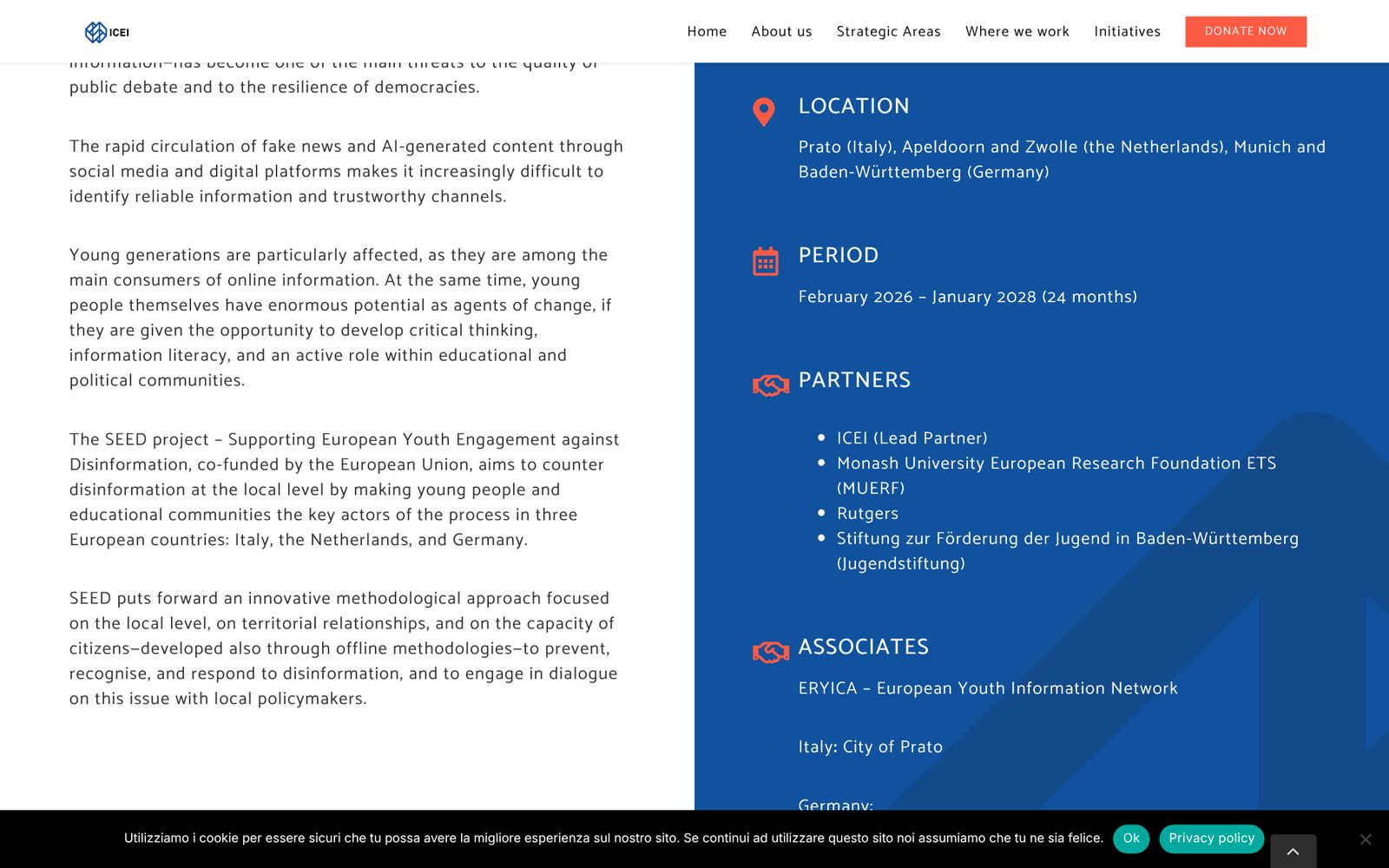
Duration: February 2026 to January 2028 (24 months). Places: Prato (Italy); Apeldoorn and Zwolle (the Netherlands); Munich and Baden-Württemberg (Germany). Direct beneficiaries: young people aged 16 to 24, youth workers and local policymakers.
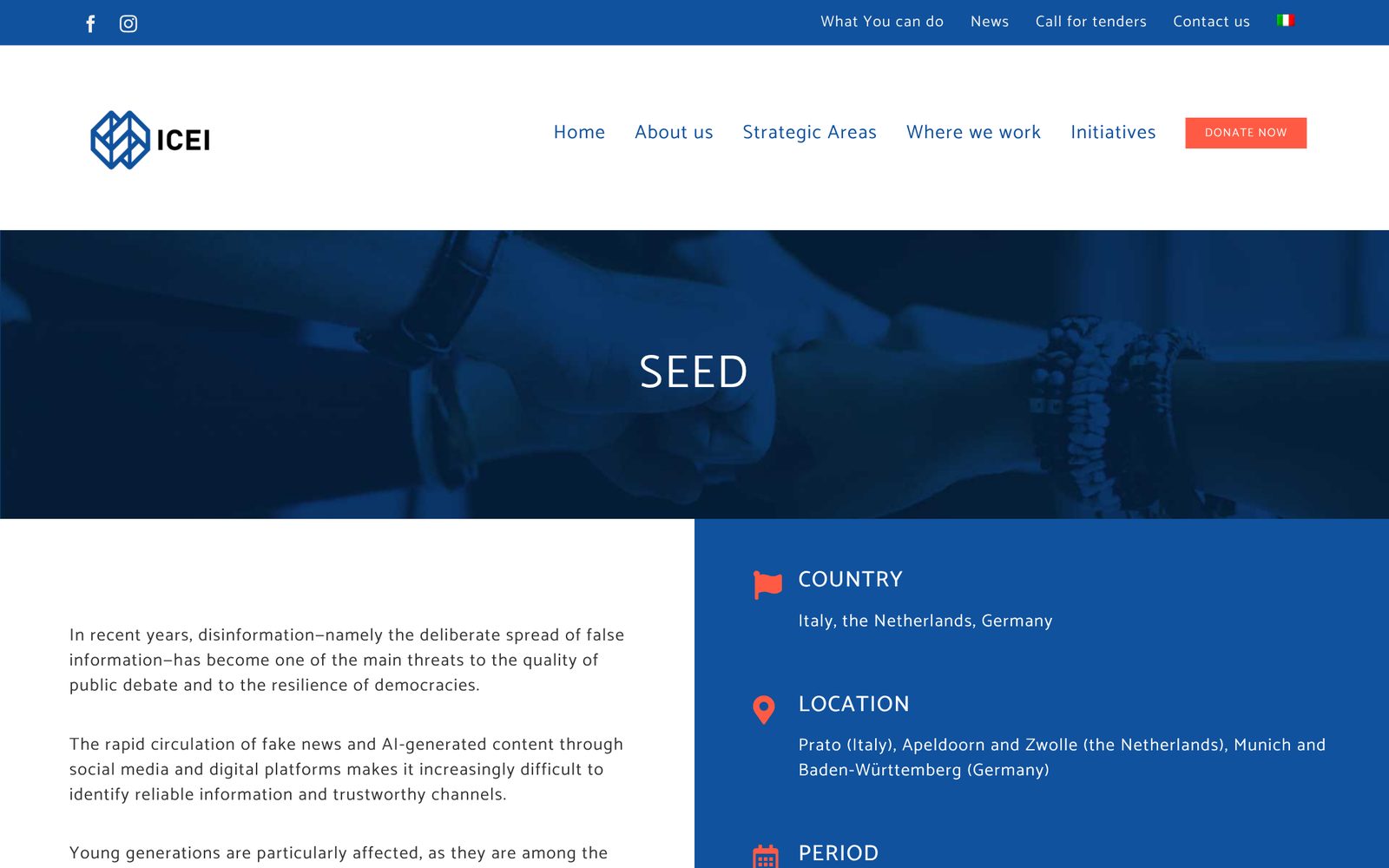
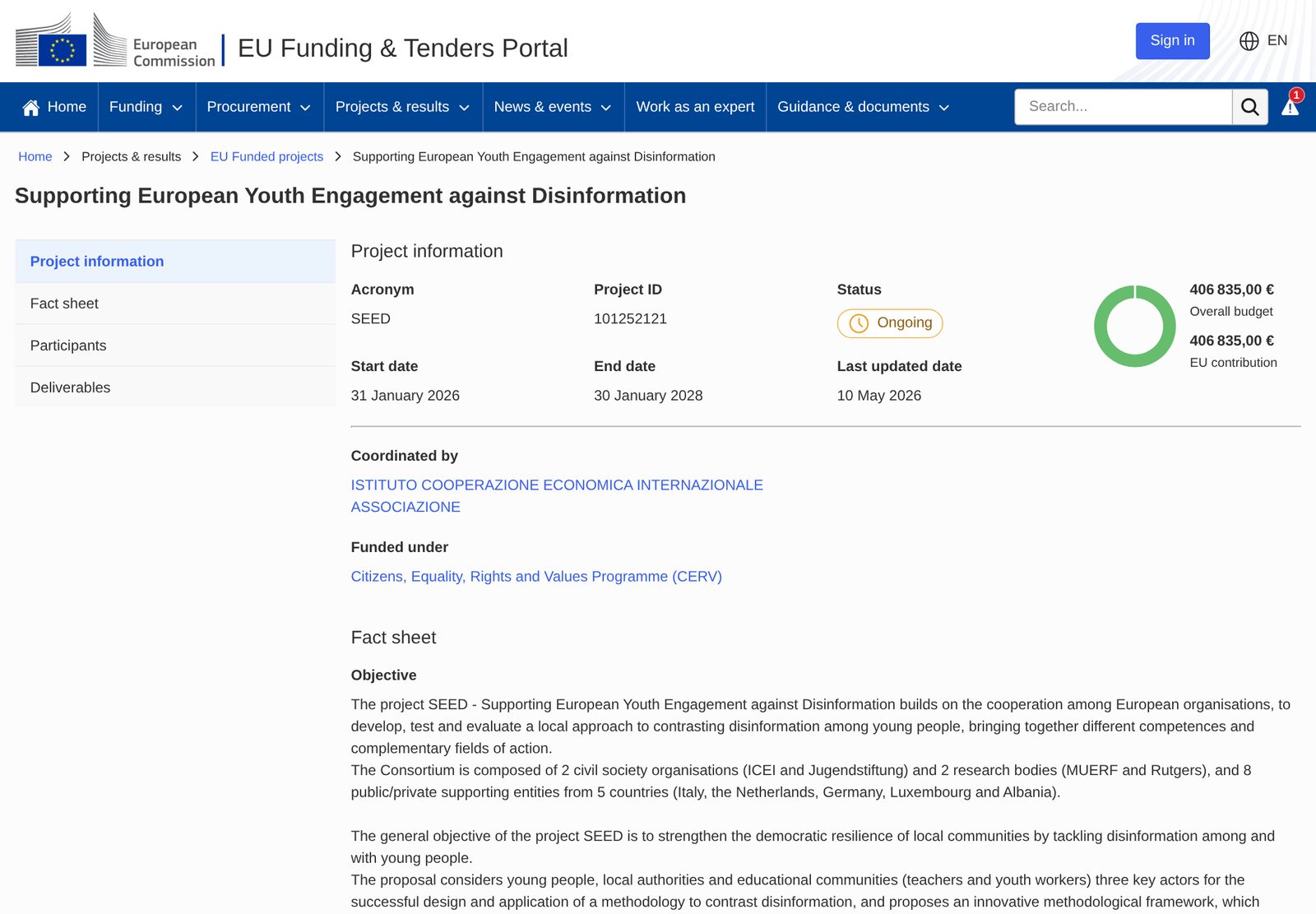
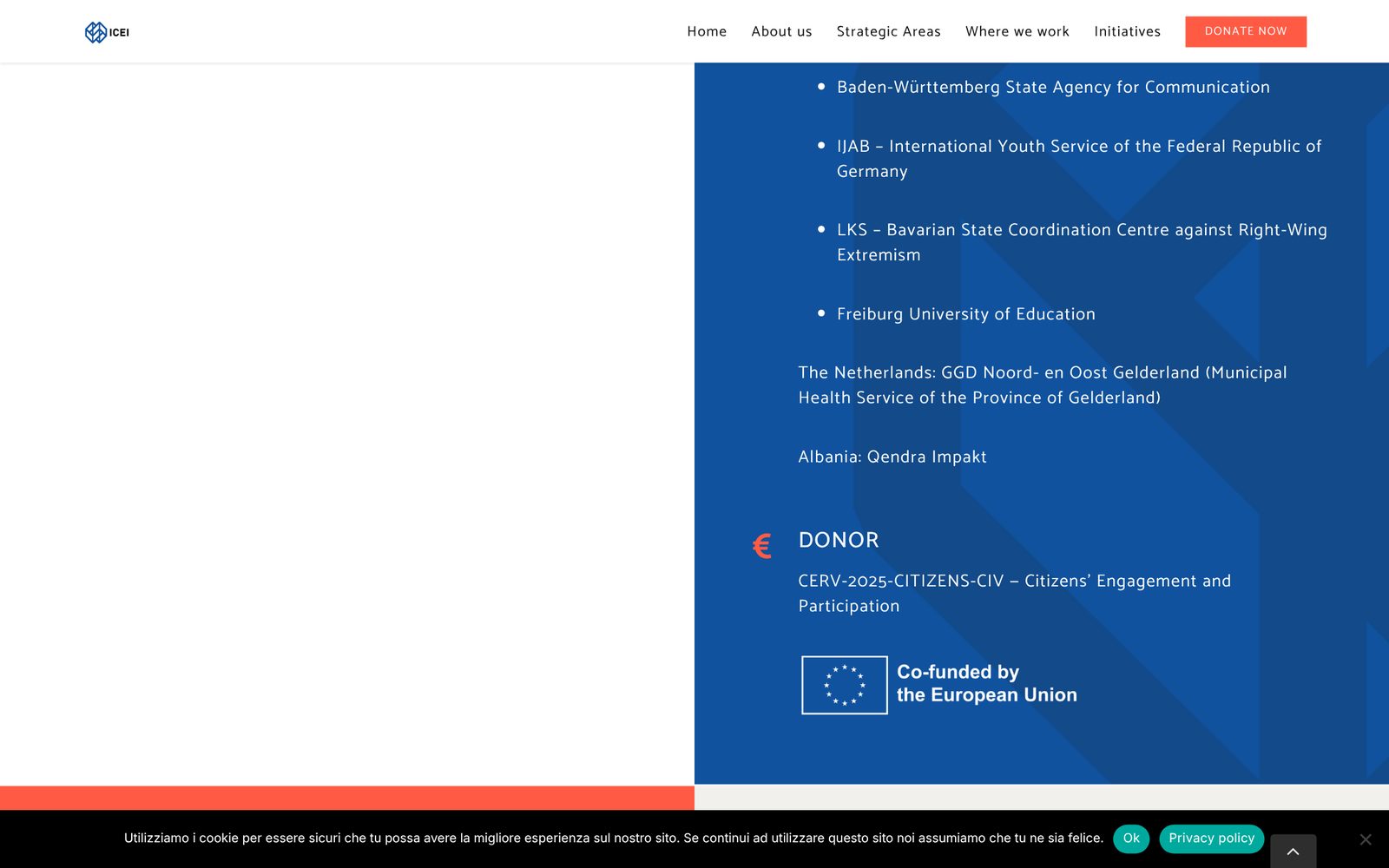
The SEED page on the ICEI website, with country, location and periodThe SEED project record on the EU Funding & Tenders PortalThe SEED page on the ICEI website: partners and associatesThe SEED page on the ICEI website: objectives and activitiesThe CERV programme overview on the European Commission website
European Commission logo, the funder of SEED (CERV programme)
European Commission logo, the funder of SEED (CERV programme)European UnionCo-funded by the European Union, Citizens, Equality, Rights and Values programme

Objectives

The general objective is to strengthen the democratic resilience of local communities by tackling disinformation among and with young people. SEED builds on cooperation among European organisations to develop, test and evaluate a local approach to countering disinformation among young people, bringing together complementary competences and fields of action.

Young people, local authorities and the educational community (teachers and youth workers) are the three key actors. The project involves a wide range of young people from different backgrounds in co-designing and implementing solutions within their local communities, with a direct connection to local policymakers.

  • SO1: empower civil society organisations, especially those working with youth, in different European cities to support young people in combating discrimination.
  • SO2: strengthen young people’s resilience and preparedness to counter disinformation in their local context and online.
  • SO3: increase the engagement of young people from diverse backgrounds in the democratic and civic life of their cities, and their influence on local authorities.

Why it matters

Disinformation, the deliberate spread of false information, is one of the main threats to the quality of public debate and to the resilience of democracies. Fake news and AI-generated content circulate rapidly through social media and digital platforms, which makes reliable information and trustworthy channels harder to identify. Young people are among the main consumers of online information and are particularly affected. They are also agents of change when they can develop critical thinking, information literacy and an active role in their educational and political communities.

Approach and activities

SEED proposes a methodological approach built on offline and territorial relationships, and on young people creating local support networks. The work in each of the five target territories proceeds in stages:

  • Analysis of each territory’s vulnerabilities: thematic areas such as health or vaccines, and target groups or communities such as migrants, Roma communities and LGBTQ+ communities.
  • Mapping of allies and actors ready to act against disinformation: the “trust networks”.
  • Training of trust-network practitioners and young people from each territory to recognise and respond to disinformation, and co-development of local strategies and pilot actions.
  • An in-depth phase of “counter-disinformation labs”, followed by evaluation.
  • Refinement of the strategies, which local trust networks and institutions then take forward.

Partners meet in person in Italy at the start, in the Netherlands about midway and in Germany at the final event. A community of practice, set up after the meeting in the Netherlands, continues the exchange online.

My role

I am a Chief Investigator on SEED and lead the Malaysian consortium arm through the Monash University European Research Foundation (MUERF), providing computational disinformation modelling and cross-regional comparative analysis. MUERF is one of the two research bodies in the consortium and is based in Prato, Italy.

First results

The first results, published on 1 October 2026, mapped 377 young people and professionals in Italy, Germany and the Netherlands, with three national mapping reports delivered. Resources published so far cover the training and thematic event in Italy and the “Mapping weak spots and building trust networks” work in Italy, the Netherlands and Germany.

Consortium

Eight supporting entities from five countries (Italy, the Netherlands, Germany, Luxembourg and Albania) are associated with the project.

  • Italy: City of Prato; ERYICA, the European Youth Information and Counselling Agency.
  • Germany: Baden-Württemberg State Agency for Communication; IJAB, the International Youth Service of the Federal Republic of Germany; LKS, the Bavarian State Coordination Centre against Right-Wing Extremism; Freiburg University of Education.
  • The Netherlands: GGD Noord- en Oost Gelderland, the Municipal Health Service of the Province of Gelderland.
  • Albania: Qendra Impakt.
OrganisationCountryRoleTypeEU contribution (EUR)
ICEI: Istituto Cooperazione Economica InternazionaleItalyCoordinatorCivil society organisation105,998
Monash University European Research Foundation (MUERF), PratoItalyPartnerResearch body68,665
Stichting Rutgers, UtrechtNetherlandsPartnerResearch body103,664
Stiftung zur Förderung der Jugend in Baden-Württemberg (Jugendstiftung)GermanyPartnerCivil society organisation128,508
Total EU contribution and overall budget406,835

Who benefits

Direct beneficiaries are young people aged 16 to 24, youth workers and local policymakers. Indirect beneficiaries are the communities where the partners and associates work and, more broadly, European citizens.
Project facts

ItemDetail
ProjectSEED: Supporting European Youth Engagement against Disinformation
EU project ID101252121
StatusOngoing
Period31 January 2026 to 30 January 2028 (24 months)
PlacesPrato (Italy); Apeldoorn and Zwolle (the Netherlands); Munich and Baden-Württemberg (Germany)
ProgrammeCitizens, Equality, Rights and Values Programme (CERV)
TopicCERV-2025-CITIZENS-CIV: Citizens’ Engagement and Participation
Type of actionCERV Lump Sum Grant
KeywordsDisinformation; youth engagement; democracy; local level; trust networks; multi-stakeholder approach; interculturalism; educational community; local authorities

Sources: the ICEI project page and the EU Funding & Tenders Portal project record.

In each domain 2

Data, Democracy & Disinformation primary domain

Measuring how disinformation and platform algorithms affect elections and civic space in Southeast Asia and Europe.

This is the main home of the item, and it also appears in Econometrics. The Democracy portfolio has 29 items, 19 of them shared with other domains.

Open in the Democracy portfolio · Democracy CV

Econometrics also in this domain

Time-series, volatility, causal-inference and machine-learning methods, and the computing to run them.

Listed here as well as in Democracy. The Econometrics portfolio has 42 items, 39 of them shared with other domains.

Open in the Econometrics portfolio · Econometrics CV